Speaker Recone Kits Explained: Why Original Parts Matter
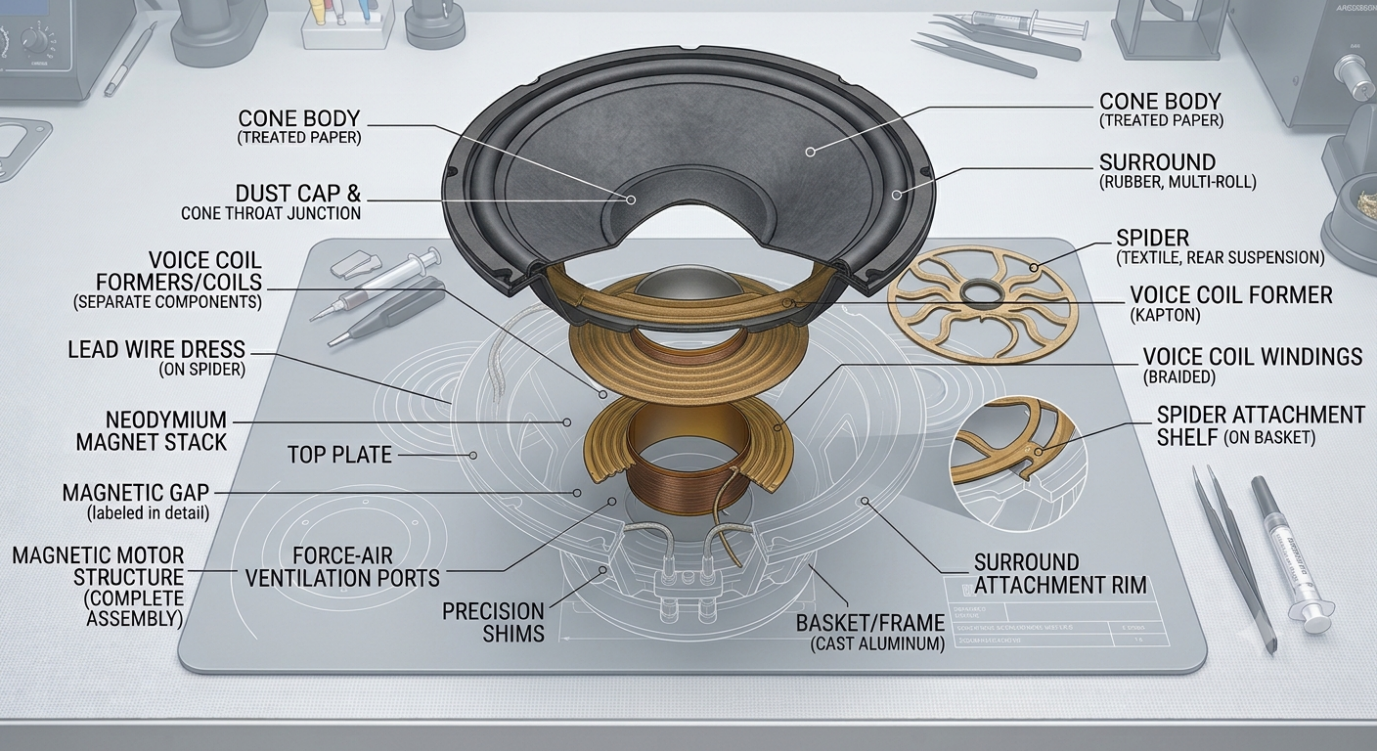
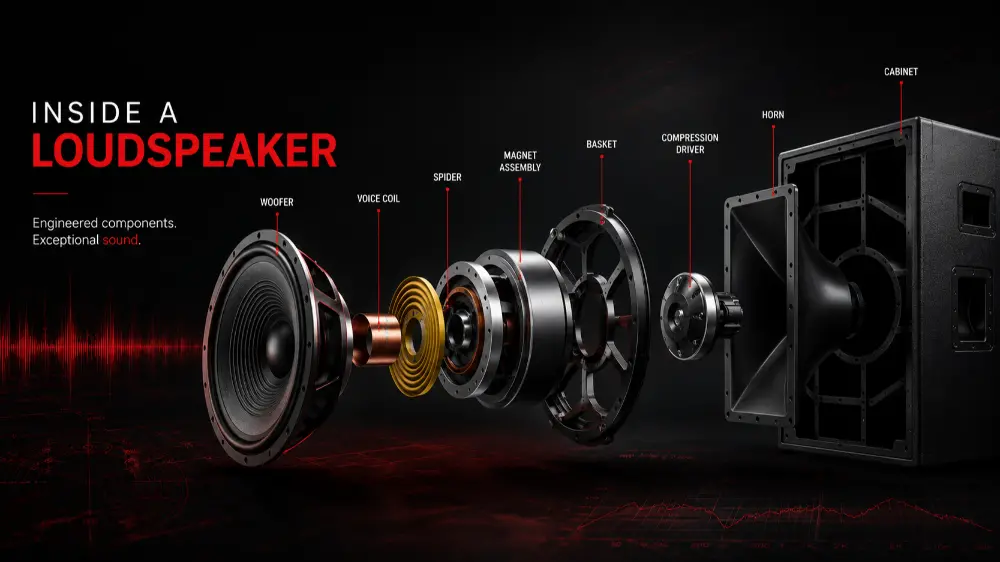
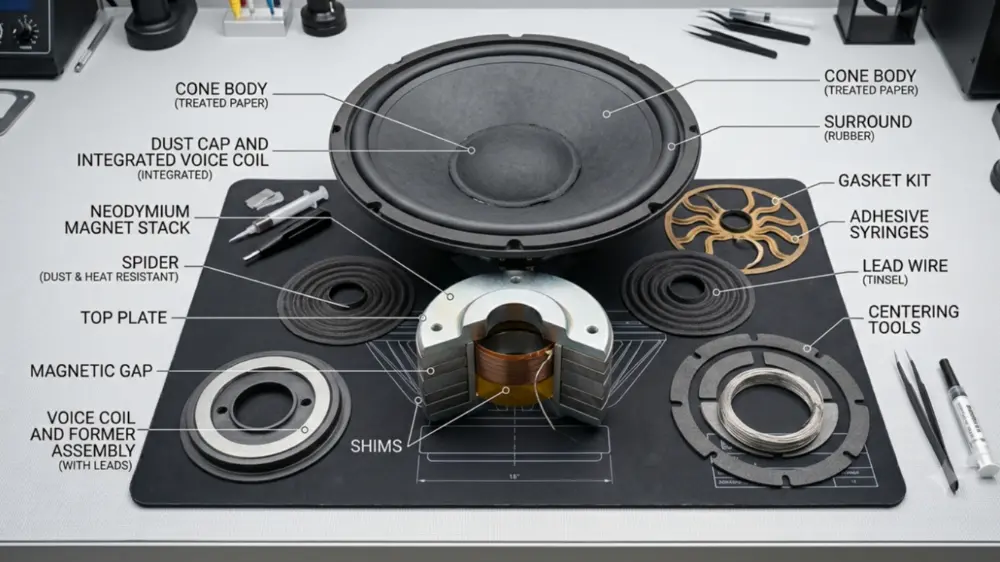
Conventional loudspeakers comprise of a cone crafted from paper, Kevlar, carbon fibre, or metal alloy, permanently attached to a precision-wound voice coil. This assembly is suspended directly within a powerful magnetic motor structure, using a permanent magnet, top plate, and centre pole piece. The entire moving assembly is held together by a flexible rear spider and an outer surround. This is then securely mounted onto a rigid chassis that can be made either of cast-aluminium or stamped-steel chassis also known as the basket.
All conventional Loudspeakers have a paper/ Kevlar/ metal / composite material cone with a voice coil attached to. This is placed inside a magnetic secured by a basket.
In the course of use and with time and misuse, the loudspeaker may fail due to aging of the cone material is a common problem most users face. Without realizing the criticality of a recone kit, they send it to any recon shop and get it repaired.
One of the biggest myths is that any recone kit of the same size and voice coil size can be used to replace the original one. It is common to hear an employee claim they know a recone guy and can get the driver recone at a fraction of the cost of an original kit. A recone kit is like an engine piston and has to be identical to the original one. The reconning of a loudspeaker is not a generic repair process akin to patching a tire, but an electro-acoustic transducer. A Loudspeaker driver has tight tolerances and a precisely calibrated system where every mechanical component needs to couple perfectly with the magnetic motor structure. Using any recone kit without knowing every parameter will almost always result in poor acoustic performance, high distortion, or immediate mechanical failure.
To ensure a recone kit is fully compatible and will restore a driver to its original design specifications, several critical criteria must be met:
· Precise size of the voice coil former
· Precise dia of voice coil
· Precise resistance and length of the copper wire wound on the former.
· Height of the voice coil
· Type of former material
· Strength or compliance of the two suspensions
· The weight of the cone and coil assembly
· Paper cone angle
Explaining the above to understand clearly their role. The voice coil is the heart of the driver, and its fit within the top plates of the magnetic gap and has tolerances in fractions of a millimetre. Even a tiny deviation in voice coil diameter will cause the former to rub against the pole piece or top plate, causing distortion and at times may burn or catch fire under power.
The height of the copper or aluminium winding relative to the magnetic gap dictates the excursion also called X max, which is the maximum axial movement. If a replacement coil has a shorter or taller winding height than the original, it will alter the motor strength, change its characteristics called the Thiele-Small parameters thereby reducing the power handling.
The former, which is the cylinder on which the voice coil is wound, is made from several types of materials, such as Kapton, fiberglass, or in cheaper speakers’ metal. This must be designed to dissipate the exact heat produced by the voice coil effectively under high thermal stress.
Another major challenge is the strength of the suspension and the spider. This is made from several types of material depending on the application and, of course, price. The spider (rear suspension) and surround (outer suspension) provide the restoring force that canters the voice coil and controls cone movement. A replacement spider with a different stiffness than the original one will alter the free-air resonance frequency and the total Q factor, changing the characteristics of the driver. If the suspension is too stiff, low-frequency extension is lost and if it is too loose, the cone will leave its magnetic space losing control and adding distortion and may even bottom at full power which can be heard like a shot fired from a rifle.
However, one of the most important factors that affects efficiency is the total moving mass, which includes the cone, dust cap, voice coil, lead wires, and a proportional share of the suspension. Using a heavier or lighter cone changes the driver's resonant frequency and overall sensitivity (SPL). A heavier cone causes the driver to loose high-mid efficiency, while an excessively light cone can shift frequency response peaks outside the intended crossover range. Moreover, the lead wires connecting the cone to the amplifier to the voice coil via the terminal inputs must be correctly routed and tensioned. Improper lead wire lengths will cause snapping noises during high excursion, leading to fatigue failure and mechanical failure in the course of time.
The physical profile of the cone which is the depth the paper thickness and the concentric circles along with its depth, angle, and type of material determine how sound waves propagate across the frequency spectrum. A replacement cone with different rigidity or mass distribution will alter high-frequency roll-off and introduce unwanted resonance peaks, rendering pre-existing crossover design ineffective. The speaker will sound different and strange.
Ultimately, a successful recone requires a kit engineered specifically for that exact transducer model to preserve its original electro-acoustic integrity.