Controlling Noise Bass and Speech Intelligibility in High-End Interiors
How do we achieve high speech clarity and precise bass control without sacrificing aesthetics like marble, glass, and exposed concrete? More importantly, what acoustic materials work best to solve these challenges without being seen?
Uncontrolled reflections from hard room boundaries cause ambient human and equipment noise to build up rapidly. This severely degrades Speech Transmission Index (STI). STI ranges from a number 0 that is unintelligible to 1.0 that is seldom achieved and the best possible. Target STI for fine dining/hospitality is typically 0.60–0.75, balancing conversation privacy between tables with intelligibility at individual tables. A STI of under .5 is generally unacceptable and below . 4 turns a normal conversations or musical performances into a muddy, unintelligible experience. Beyond guest chatter, this problem includes mechanical and service noise—such as blenders mixing cocktails at the bar or cutlery clattering in fine-dining spaces and the list goes on.
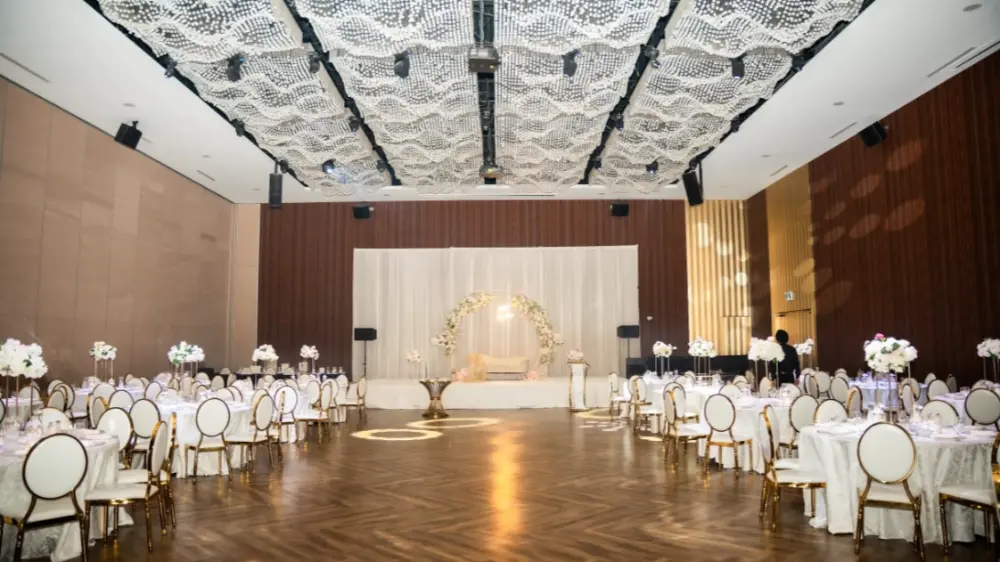
Most designers view spaces strictly through a visual lens, incorporating high-end but highly reflective materials: floor-to-ceiling glass, marble, porcelain tile, polished wood, gypsum board, and exposed concrete. Architectural features like coffered ceilings, domes, and sloped ceilings further compound these acoustic issues.
To bridge this gap, we must understand the fundamental physics behind these architectural challenges and explore how layout decisions, hidden acoustic treatments, and thoughtful system designs can balance visual luxury with noise control and pristine audio performance. Though all these the solutions are helpful but need careful simulations for accurate results
Understand your room and effect of its Geometry on sound:
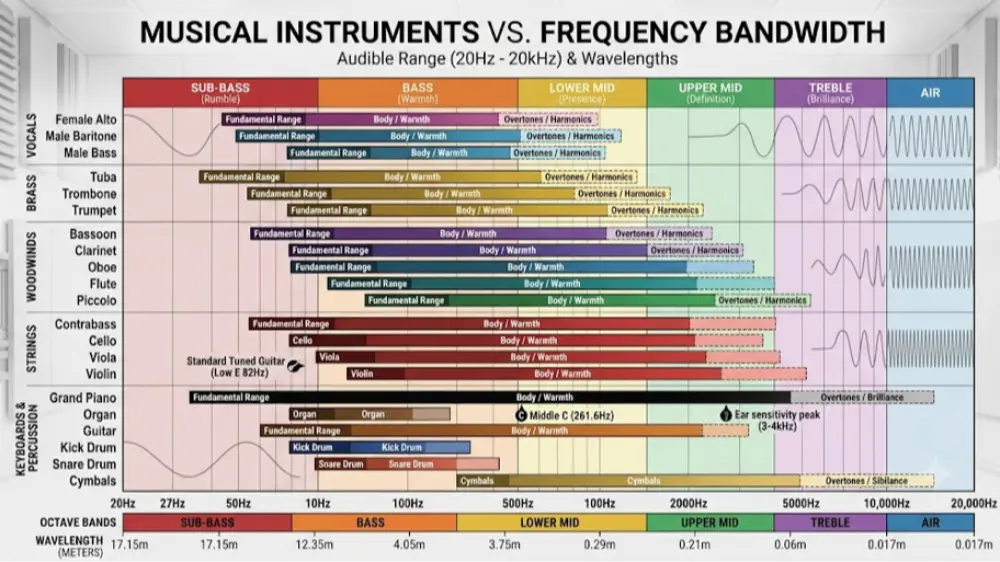
Room dimensions dictate how sound behaves in a closed environment. Standing waves occur when direct low-frequency waves from a Subwoofer interacts with reflections bouncing off hard parallel /walls and ceilings. This creates stationary points of maximum pressure variance (antinodes) near boundaries and zero pressure variance (nodes) toward the centre of the room. In technical terms, this results in localized pockets of extreme high and low Sound Pressure Levels (SPL)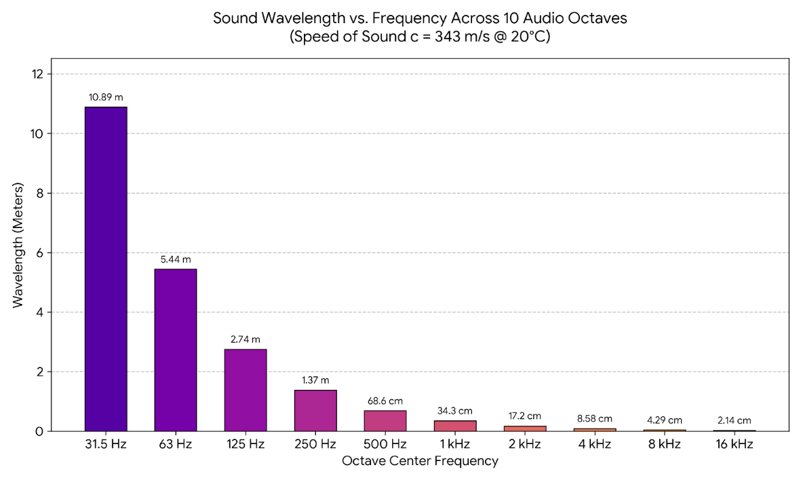
- House music : lots of sub
- Western Classical: lots of low mid, mid’s and highs
- Commercial music : a mix of everything
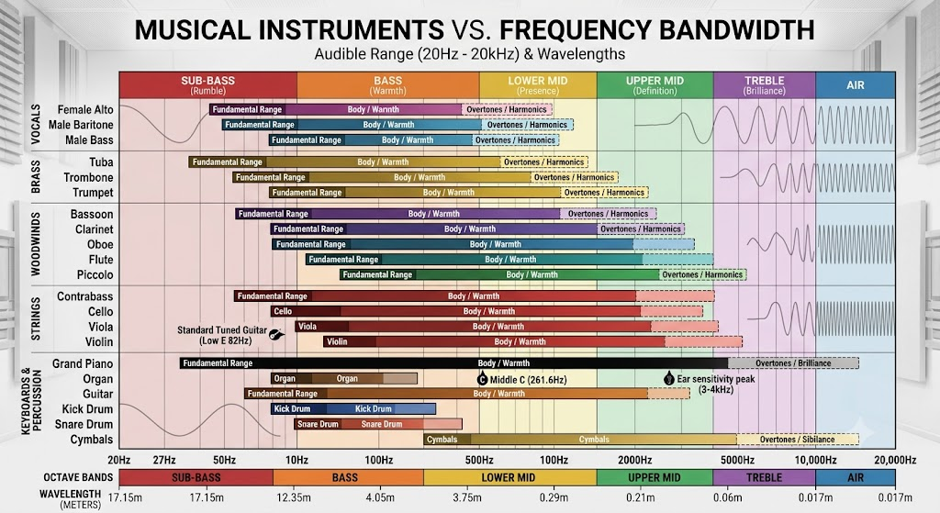
When low frequencies below 200 Hz emanate from a subwoofer it has long wavelengths with the maximum energy and can form discrete standing waves called room modes. The modes are dependent on the room size. Symmetrical Spaces like Cube-shaped rooms or spaces where length, width, and height are identical or exact multiples of one another suffer from severe modal stacking. This stacking generates harsh, booming bass peaks alongside deep phase cancellations (nulls) where bass completely disappears. Resulting in a persistent, low-frequency hum that fatigues guests and ruins the ambiance, often causing patrons to leave early.
Dimensional Ratios
To avoid modal stacking, Rooms with dimensional ratios of 1 : 1.6 : 2.33 (Height : Width : Length) is often used as a standard room size to avoid room modes however the ideal standard acoustic ratios from L.W. Sepmeyer/Louden are  or
or  , or
, or 
This ratio distributes low-frequency resonances evenly across the space for a smooth bass response. As a rule of thumb: Never design rooms with dimensions that are identical or simple integer multiples of one another. Irregular rooms without domes or concave surfaces are the best for noise control.
The Two Low-Frequency Bands
Low frequencies behave differently across two main operational zones:
- Below 100 Hz (Sub-Bass Zone): Wavelengths range up to 56 feet (17 meters) at 20 Hz—often longer than the room itself. These massive waves bounce between parallel walls or floor and ceiling, and lock within the walls. This causes long low-frequency decay times, creating a muddy boom that lingers in the space at times for a few seconds even after the music stops.
- 100 Hz to 200 Hz (Upper Bass / Lower Mid Zone): Whether in music playback or environmental noise, the 100 Hz to 200 Hz range consists of sound waves that are physically between 5 and 11 feet long, which easily bend around obstacles and also bounce off walls. These reflections collide with direct sound to cause sharp cancellation called nulls or boomy boosts right where male voice chest voice body exists. In general noise control, this same wave behaviour allows low-frequency hums like HVAC blowers, traffic, or generator noise build up in rooms specially in the corners.
Solutions: Listener sitting too close to a hard wall causes an artificial mid-bass bump that smears vocal clarity. It’s always good to Maintain at least more than 3 feet between key seating areas and rear boundaries whenever possible.
2. Coffered Ceilings: Architectural Feature vs. Sound Trap
Coffered ceilings break and scatter/ diffuse mid- and high-frequency sound waves that where the size of the coffer wells is close to the length of these sound waves, reducing flutter echoes across the room.
However, low frequency bass waves being larger in length than the coffer, for example 50 hz is about 20 feet that completely ignore 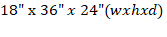 coffer and treat the ceiling as a flat wall.
Additionally, untreated coffer acts as resonator. Mid- and high-frequency sounds bounce inside these empty wells, trapping acoustic energy and reflecting it back with a slight delay. This delay degrades voice clarity and disrupts speech intelligibility.
The Solution:
Design coffers with different dimensions, Dampening the interior faces of the coffer wells using concealed Porus acoustic material with an NRC of > .9 NRC. The material should be installed with a reasonably large air gap depending on the maximum target frequency you intend absorbing. For Room where human sound makes these coffers into acoustic traps acting as architectural diffusers. Absorb sound by converting particle velocity into heat via viscous friction within porous cavities. Maximum absorption occurs where particle velocity is highest ( away from hard boundaries). Saying that porous absorbers installed directly on coffer surfaces or walls cannot absorb deep sub-bass. To absorb sub-bass efficiently without deep cavities, tuned resonant absorbers called Helmholtz resonators, membrane/limp-mass bass traps) is not possible.
3. Understanding Domes
Domes are significantly more destructive to room acoustics than flat ceilings due to geometric focusing.
A concave dome acts like a giant parabolic mirror collecting sound waves hitting its surface and focuses them as a hotspot on the floor. This leaves the areas around it in an acoustic shadow. Sound creeps along the smooth perimeter walls within the dome to optical centre and then reflects it back. This is also called the whispering gallery effect. A whisper on one edge of the dome can be heard on the other edge even in case of a large dome for example 15-meter domed reception of hall can often be heard clearly on the opposite end.
The challenge when domes directly sit over a performance Stage or dance floor are serious and create something called stage noise. When musical Instruments directly fire upward into a dome, it reflects the incident rays back to the stage in an out-of-phase signal. This creates massive phase smearing for performers and drives open microphones into immediate, feedback loops. This reflected sound bouncing off a dome arrives delayed by  (where
  is the dome height from the floor). The human brain perceives this discrete arrival as a harsh echo. This destroys transient punch, degrades speech intelligibility, and turns live music into a mess. There reflections increase the ambient background noise and even degrading private table conversations across the venue.
The Solution: Domes should ideally be avoided in performance or dining spaces. However, if they are non-negotiable aesthetically, they can be addressed by Installing a flat or inverted-convex acoustic barrier beneath the dome, filling the top of this barrier with high-absorption material. This prevents audio waves creeping in from the sides to fall on the inverted dome and get absorbed. The other option is hanging a flat acoustic barrier covering 50 to 60% of the size of the dome opening. This preserves the visual illusion of height while concealing up-lighting that illuminates the dome interior.
4. Large Hard and flat walls:
When sound hits large flat and hard surfaces like walls of a venue it acts as acoustic mirrors. Corner intersections, are far more destructive from where energy amplifies and bounces back and forth rapidly, creating mid and high-frequency flutter echoes and artificially inflating the overall Reverberation time. This sounds spooky and you may in certain rooms even hear your own footsteps making you feel someone if following you. These sound effects are nothing but your own movement and caused by large and hard surfaces.
If we choose to put in a sound system or even people in a large room with high walls and large flat untreated flat ceiling and walls , delayed reflections mix with direct sound causing phase smearing and degrades the Speech. Reflected energy accumulates, raising the ambient noise floor. Guests automatically speak louder to be heard over the rising noise. Venue operators turn up the sound system volume to compensate for the noise. This higher sound pressure drives even more reflected energy back into the crowd and also the stage. This not only, severely reduces the gain-before-feedback but everyone ends up shouting at each other. The audio system becomes unstable and distorts long before achieving clear, comfortable volume levels.
Solution: Apply a Seamless acoustic plaster directly over rigid backing board or acoustic substrate panels. They can match a traditional lime-wash finishes while achieving high sound absorption (NRC ratings up to 0.85–0.90) by remaining acoustically porous.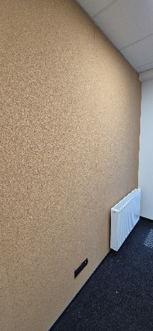
We call also use heavy acoustic drape/ sheer fabrics or even a translucent micro-perforated or dense-weave threads to absorb mid-to-high frequency reflections off curtain wall. Positioning the heavily pleated drape at least 100mm from the glazing maximizes absorption in the air cavity without obstructing natural light.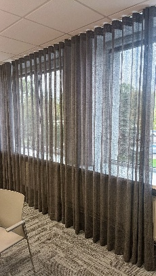
Micro-fine linear slots allow acoustic energy to pass through the finished face. Behind the millwork, a non-woven acoustic fleece provides high airflow resistance, while a cavity filled with high-density mineral wool absorbs lower mid frequencies to prevent room flutter and boominess. This can be in any shape and size. And not necessarily slotted .
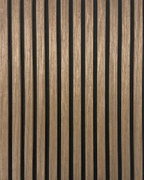
Acoustic excellence does not require compromise on visual luxury. By managing room geometry early in the schematic phase, controlling dome and coffer geometries, and concealing advanced acoustic absorbers within structural elements, designers can craft visually stunning environments that deliver exceptional speech clarity, controlled bass response, and refined acoustic comfort. Get a Free Audio Consultation
Frequently Asked Questions About Room Acoustics
What is room acoustics?
Room acoustics is the way sound behaves within an enclosed space, including reflections, reverberation, absorption and low-frequency response. Good room acoustics helps deliver clear, balanced and comfortable sound.
Why does room geometry affect sound?
Room dimensions and geometry influence reflections and standing waves. Poor proportions or parallel surfaces can create uneven bass, echoes and inconsistent sound levels.
What are room modes?
Room modes are resonances created when low-frequency sound waves interact with room boundaries. They can produce areas where bass becomes excessively loud or almost disappears.
Why does bass sound different in different parts of a room?
Low-frequency wavelengths are long and interact strongly with walls, floors and ceilings. This creates peaks and cancellations, making bass sound different at different listening positions.
How do hard surfaces affect sound?
Materials such as glass, marble, concrete and polished wood reflect sound rather than absorb it. Excessive reflections can increase reverberation, background noise and reduce speech clarity.
Do domed ceilings cause acoustic problems?
Yes. Concave domes can focus sound toward specific areas, creating acoustic hotspots, delayed reflections and feedback problems. Proper acoustic treatment is important when domes cannot be avoided.
How do coffered ceilings affect acoustics?
Coffered ceilings can scatter and diffuse mid- and high-frequency sound, but untreated coffers may also reflect sound within the cavities. Concealed acoustic absorption can improve their performance.
How can acoustic treatment be hidden inside a luxury interior?
Acoustic materials can be integrated behind architectural finishes, millwork, acoustic plaster, drapes and other concealed surfaces. This allows spaces to maintain their visual design while improving acoustic performance.
How does room acoustics affect speech intelligibility?
Excessive reflections and reverberation can make speech unclear and reduce intelligibility. Proper acoustic treatment helps control reflected energy and improve speech clarity.