Auditorium Sound Systems the Complete Guide to Design Installation
Auditorium Sound Systems: The Complete Guide to Design, Planning & Installation
When planning a campus multipurpose auditorium, one of the most frequent asked questions
Introduction – Why Auditorium Sound System Design Matters
How to Determine the Right Size of an Auditorium Sound System
At first glance, it feels like a straightforward technical inquiry based purely on square footage or seating capacity. However, any experienced electro acoustic engineer will tell you that is not all true. Speaker count, placement, power and system topology can only be decided based on application, number of audiences, shape, architecture, and acoustics.
One of the most common pitfalls in campus decisions are budget allocation. Institutions routinely spend millions of dollars constructing breathtaking interiors, elaborate stage rigging, and investing in flashy lighting, large screens. Yet, when it comes to the audio system, they compromise for financial reasons, opting for a scaled-down, consumer-grade PA system without professional engineering guidance or proper acoustic simulations. Driven by vendor recommendations and without any scientific basis audio and acoustics are deployed. This false economy always backfires. Resulting in either an over or under compensated space with an underpowered, poorly designed audio system that will inevitably fail during a high-profile university events, graduations, and performances due to constant ringing and inadequate coverage.
Too often, campus auditoriums are built as architectural showcases with visual grandeur. In fact, an auditorium should be designed keeping in mind Audio first and everything else around it. This mismatch between form and acoustic function frequently leads to compromised sound quality, early system feedback, and ultimately, wasted capital.
Key Technical Factors in Auditorium PA System Design
This blog explores some factors that dictate the true size, scale, and design of an auditorium’s Public Address (PA) system, helping architects and interior designers including commercial /educational institutions make informed decisions before laying the first brick.
The first step before calculating throw distances or speaker quantities, you must define how the space will actually be used. A multipurpose campus auditorium rarely serves just one function it must adapt to morning assemblies, guest lectures, cultural dance performances, dramatic student skits, and full-scale rock concerts. Each use case places vastly different demands on the audio system discussed under.
1 Speech-Only Applications
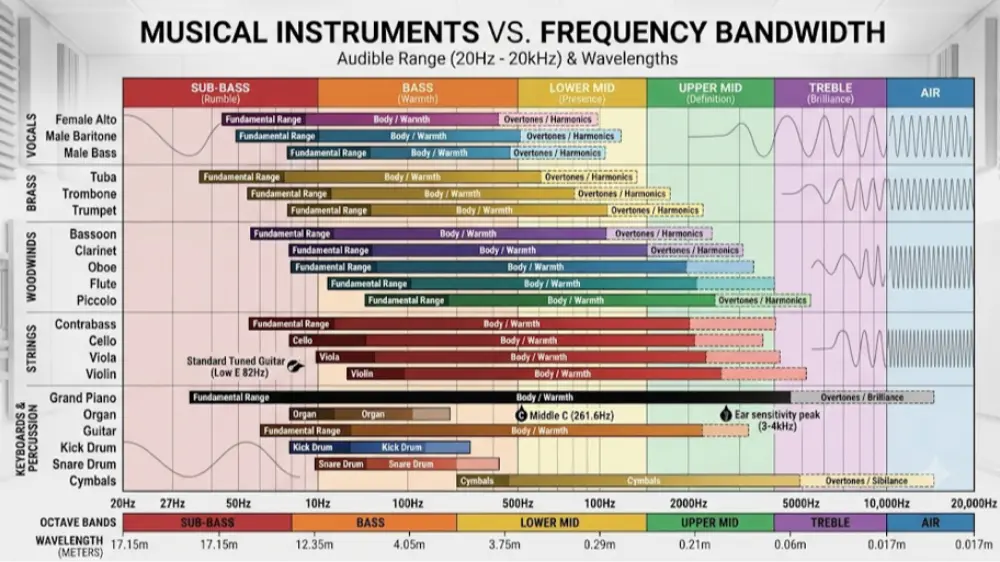
If the auditorium is intended strictly for lectures, panel discussions, and institutional addresses, the system requirements are relatively modest. Speech intelligibility the clarity of the spoken word means a speech transmission index (STI)of better than.6 . This is the primary objective here which comes with adequate SPL and coverage. Because human speech occupies a narrow frequency band, the system does not require massive low-frequency reinforcement or extreme high SPL (Sound Pressure Level) capabilities. A smaller, well aligned distributed or tightly focused system ensuring proper imaging* will suffice. A properly designed audio system will work well as all we need is to cater to a frequency band of between 100hz to 10khz which is where the human vocal sits. The size of and type of PA system will be determined by the height of the Auditorium and the maximum distance of throw.
2. Speech and Light Background Music
When events incorporate multimedia presentations, background tracks, or light musical performances alongside spoken word, the acoustic requirements expand. To deliver a rich listening experience, the system needs a slightly larger footprint, notably incorporating subwoofers for low-frequency extension. This ensures that music feels full and balanced rather than thin and tinny. This will increase the cost to the system by about 40% as now our frequency bandwidth is some 40 Hz to 20 Khz .
3. Theatre, Plays and Open-Microphone Applications
As soon as a space hosts theatrical productions with multiple open microphones on stage often exceeding 10 live open mics, the acoustic challenge multiplies. Multiple open microphones drastically increase the risk of acoustic feedback and the dreaded whistling or ringing of the system. To combat this, the PA system must be designed to be big enough with a powerful point source or line array Systems deployment, requiring precise speaker dispersion control, professional mixing hardware, and careful stage geometry and acoustics . This helps achieve higher gain before feedback. Here the cost of the system increases substantially.
4. Live Bands and High-Impact Productions
If the campus auditorium aspires to host student rock bands, cultural music festivals, or professional touring acts, a simple institutional PA will fall short. At this level, you need serious large PA with extensive dynamic headroom, with properly placed delays. A high-powered system enhances music dynamics and guarantees vocal presence even when a large band is playing at full volume and multiple microphones are active on stage. Systems like this needs to have multiple subwoofers preferably cardioid subs to endure minimum low frequency bleeding on to the stage reducing stage noise and low frequency feedback. This ensures smaller monitors and saving cost of on-stage monitoring. However, such systems are expensive.
Auditorium Sound System Layout and FOH Control Position
Once the applications are established, the physical architecture of the hall is most important. The shape and layout of the room dictate how sound waves propagate, reflect, and dissipate. Several critical technical parameters must be factored into the design.
The distance the sound must travel from the Front of House typically the FOH is positioned above and on the lip of the stage to the furthest seat in the house. Moreover, the overall shape of the venue whether rectangular, circular, or fan-shaped fundamentally alters acoustic behaviour and also help us deign the main FOH and any delays required. The presence, number, and depth of balconies, as well as side balconies need to be properly covered as they create an acoustic shadow. They trap sound if not properly addressed with delay fills.
Understanding Auditorium Architecture and Acoustic Challenges
The primary goal of a modern PA auditorium is maximum speech intelligibility, which means maximizing Direct-to-Reverberant ratio. In layman terms the sound from the loudspeaker must reach the listener before the reflections from the wall reaches the ear. This is decided by the
1 Shape and geometry of the room
2 Dispersion angles of the loudspeakers
3 Placement of loudspeakers
The physical shape of an auditorium is perhaps the single most influential factor in determining both acoustic success and budgetary sanity. Poor architectural choices can turn a beautiful hall into an acoustic nightmare, requiring exorbitant amounts of corrective treatment. Various shapes discussed below.
Dome and circular Shapes
Dome -shaped or circular auditoriums are widely considered the worst possible architecture for sound reinforcement. They act as acoustic lenses, focusing and bouncing sound waves unpredictably across the room, creating severe flutter echoes, muddy reflections, and standing waves. Designing sound for a dome requires extensive and expensive acoustic treatment, alongside specialized, extremely narrow-dispersion Professional loudspeaker systems, usually omitting subwoofers entirely to prevent resonant feedback loops. Only extremely skilled team or architects, interior designers and electro accusations can get such spaces work effectively. A nightmare to design for reinforced audio.
Rectangular Spaces
Rectangular halls represent the second-biggest challenge if their dimensions are equal or multiple of each other. While easier to design than domes, rectangular rooms suffer from parallel wall reflections and room modes in event the designers have not addressed the dimensions issue are where certain frequencies cancel out or amplify unnaturally. Achieving clean sound in a rectangular venue demands significant acoustical wall treatments, panels, and bass traps, driving up construction costs.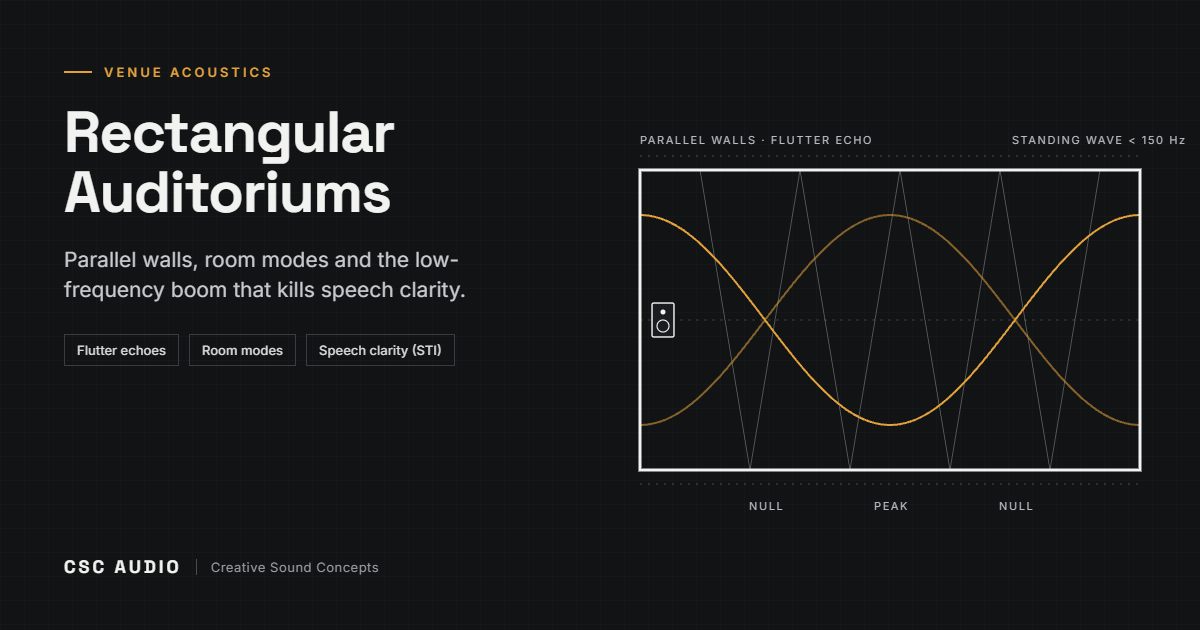
Room Modes and Low-Frequency Boom compromises the speech transmission index which is a measure of clarity of speech. Rectangular rooms with dimensions equal or multiples of each other suffer from room modes specially rigid parallel walls act like a low-frequency resonator. This dimension could create severe axial, tangential, and oblique room modes causing standing waves which result in peaks and nulls specially in the frequency ranges under 150Hz. This leads to strange and irritating boominess. Moreover, rectangular spaces though very common need serious acoustic materials /panels all over the parallel side walls just to stop flutter echoes and control room modes. It turns a performance space into an anechoic chamber where performers feel unsupported and speech loses its natural air. Even music sounds lifeless. A well-designed Audi will be a perfect mix of reflection and absorption to bring in the spark in the audio system.
Fan-Shaped Auditoriums
A fan-shaped layout inherently breaks up parallel boundaries, diffusing modal pressure nodes and resulting in a much cleaner, more predictable low-end response. However, this creates another challenge and that is the concave Rear Wall . This at times deters designers warning against fan shapes due to the concave rear wall focusing effect that focuses delayed energy back onto the stage. However, properly designed acoustics neutralizes this completely. This is done by breaking up the back wall geometry, utilizing varied absorption coefficients, and leaving an air gap behind the treatment to achieve broad-band (deep bass) absorption. This eliminates the slap back echo while keeping the rear of the room reflection-free. The cost is much more manageable than pasting all walls with acoustic padding.
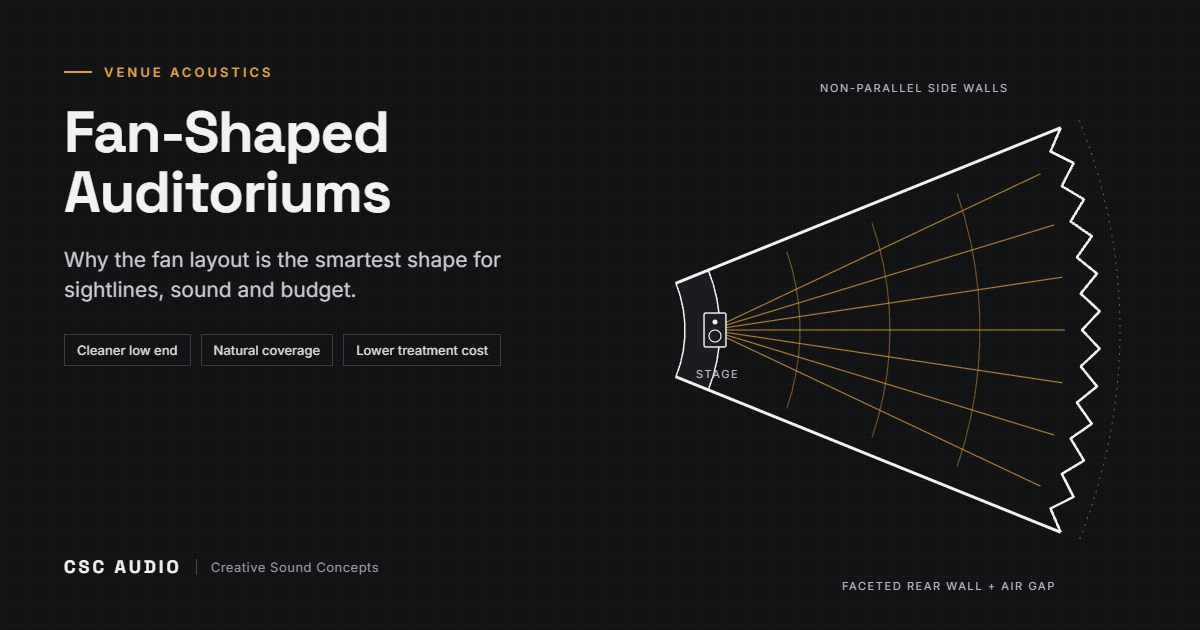
For both visual sightlines and audio propagation, fan-shaped designs are ideal. In a fan-shaped auditorium, sound spreads naturally from the narrow stage outward into a widening audience seating area, minimizing harsh parallel wall reflections. Because the architecture naturally assists acoustic distribution, this requires investment in reactive acoustic treatment can drop by as much as one-third, yielding massive cost savings that can be reinvested into superior audio gear. One of the reasons several designers prefer rectangular spaces is real estate continents, however if done smartly spaces left on ether sides can be used for services offices and even smaller halls.
Target Audio Specification
When designing the audio infrastructure, the ultimate engineering target should be clear, undistorted uniformity. Specifically, the system should be capable of delivering 95 to 105 dB of uniform SPL across the entire venue while operating at about 50% power on the live mixing console. Also called headroom. Operating a system at half-throttle ensures that the equipment
· Never has to work near its breaking point.
· Provides immense dynamic headroom.
· Allowing sudden crescendos or loud speech/ peaks to pass cleanly without compression or clipping.
· Ensures the system never rings or feeds back,
· Maintains authority clarity and pristine vocal intelligibility from the front row to the very back balcony.
· Compensated for those who speak softly on mikes and need a high gain than usual speaker.
Imaging is another most critical part of an auditorium. Several auditoriums have speakers installed on the side walls . In such a case one does not connect with the performers. It seems the performer speaking on stage while his voice is coming from the wall. The brain gets confused as it sees the performer on stage where he hears the voice from the wall. In a properly designed audio system irrespective of where you are seated, you’ll always feel the voice and performer are from the stage. This is called imaging. A well-designed sound system will ensure this is maintained.
Common Mistakes to Avoid When Designing an Auditorium Sound System
Another critical issue in auditorium design is the placement of the control room and the live sound engineer. To maximize seating capacity, venues often try to save space by placing the control room behind or to the side of the stage, or inside a small, enclosed booth at the rear of the hall. This in fact is detrimental and always creates problems for a live engineer to mix. Irrespective of most digital mixers having a facility to take controls on an I pad but that can never substitute the direct control oon the mixer . In these locations, the engineer cannot hear the main sound system properly, making it impossible to equalize the room accurately. Therefore, a fundamental rule of system design is to position the Front of House (FOH) mix position in the open seating area, approximately three-quarters of the way back from the stage. This places the engineer directly inside the primary coverage zone, ensuring they can hear the main PA clearly and manage gain and maintain even SPL, preventing the system from becoming too loud or too soft for the audience and also control any feedback specially when a live system is deployed.
Auditorium Sound System Design Checklist
Microphones , Mixers and all the hardware in the chain need to be designed and chosen properly based on the application . Even if one fails the complete system will sound terrible . Saying and getting the best gear and the highest-grade sound system will fail in the hands of an untrained operator. A capable live sound operator is not merely a button-pusher but the human link in the electro-acoustic chain. He must understand signal flow from microphone sensitivity and preamp headroom to DSP limiters that prevent distortion, feedback, and equipment damage before a single fader is raised. They must know how to carve out problematic room frequencies using subtle equalization rather than blindly boosting volume. Secondly, a great operator brings understands the room that can shift dramatically between an empty soundcheck and a full auditorium. The operator must continuously monitor speech intelligibility, tonal balance, and SPL consistency across the space, adapting quickly when a keynote speaker steps away from the podium or a live vocalist change dynamics.
An auditorium is only as good as its ability to communicate. By understanding your campus's specific usage applications, prioritizing fan-shaped or well-modelled room geometry, targeting healthy headroom (95–105 dB at 50% console power), and refusing to compromise on professional audio engineering, you can build a multipurpose space that truly resonates. Investing properly in your acoustic foundation from day one guarantees that every word spoken and every note played will inspire, engage, and endure.
Conclusion – Building an Auditorium That Sounds as Impressive as It Looks
1. If you have to do a standard box design set the dimensional ratios with H x Wx D with a proportion of  or
 ) . This will keep room modes apart and will not excite the room at low frequencies
2. Try do not deploy domes or curved walls that act as concave mirrors
3. Ensure the PA is designed around the space and not otherwise
4. Choose the size of the PA based on the usage
5. Make the stage space acoustically dead to reduce stage noise
6. Get a mix of absorption and reflection in the rest of the Audi. Must get a simulation and a RT 60 of up to 2 is fine so far as the STC better than .6
7. Keep the console and controls 2/3rd distance from the stage in the middle of the hall. If can be slightly recessed in the floor for cleared visibility of audiences behind the console
8. Stage must be solid and never left hollow and bouncy.
Frequently Asked Questions About Auditorium Sound Systems
-
How do you calculate the size of an auditorium sound system?
-
Which speakers are best for a large auditorium?
-
Is a line array necessary for every auditorium?
-
How can speech intelligibility be improved?
-
What is the importance of RT60 in auditorium design?
-
Why is professional acoustic modelling important?