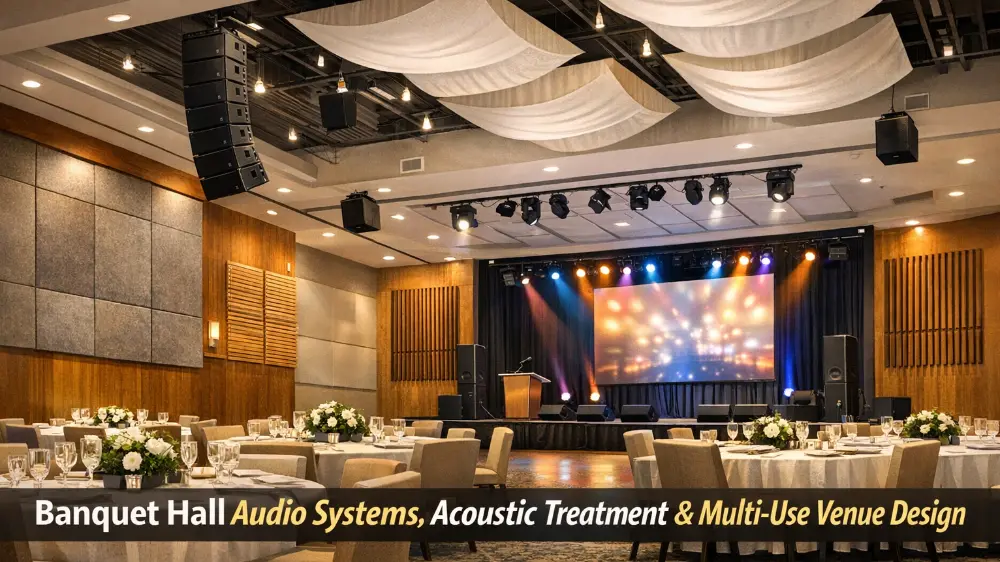
How to Design a Banquet Hall That Sells Every Square Foot
A guide to professional banquet hall audio systems, acoustic treatment, and multi-use venue design — from CSC Audio, Germany's premier commercial sound engineering brand.
Most banquet halls are designed once and compromised forever. A room built exclusively for weddings struggles with the acoustic intimacy of a corporate boardroom AV setup. A conference centre tuned for speech intelligibility fights the energy of a 300-guest wedding gala. The venues that generate real return on investment are the ones designed from the ground up to transform — seamlessly, profitably, and without a single expensive renovation in between.
This is the design brief that the best venue developers are now working on. And it starts long before a single speaker is installed.
Every square foot of a modern banquet hall must be an active revenue asset — not a passive space waiting for the next event.
The Architecture of a Commercially Viable Venue
Designing a premier banquet hall or multi-use events venue is, at its core, an exercise in balancing aesthetics with service efficiency. The planning architect sets the commercial skeleton. The interior designer builds the grandeur. But it is the electro-acoustic engineer who determines whether guests can actually hear, speak, and feel at ease — or whether they spend the evening straining to be heard across the table.
Back-of-house logistics are equally critical to long-term profitability: the proximity of an industrial kitchen to the serving floor, hidden high-capacity furniture storage, dedicated pre-function spaces, green rooms, make-up suites for artists and wedding parties, and generous, well-located restroom facilities. These elements do not just make the venue desirable for clients — they directly reduce labour costs and turnaround time between bookings.
The physical design must allow the venue to convert a high-stakes corporate summit in the morning into a high-energy wedding gala the same evening — without compromising the integrity of either event. This requires high-STC movable wall systems that partition the main hall into acoustically isolated chambers, effectively enabling the business to operate multiple revenue streams simultaneously under one roof.
One often overlooked commercial asset: intentional design for social media visibility. Every guest is a potential marketing channel. Sightlines, lighting, and staging should be composed so that smartphone video looks polished without a filter. This means variable colour-temperature lighting — cool, crisp whites for conference and seminar settings; warm, amber hues for dinners and celebrations. The hall must be designed to be filmed.
Acoustic Design: The Invisible Architecture That Defines Your Venue's Reputation
Poor acoustics are the primary cause of client dissatisfaction and lost repeat business. A venue can have exceptional catering, flawless décor, and a world-class location — and still haemorrhage five-star reviews because guests could not hold a conversation without shouting. High ceilings and hard surfaces — marble, glass, polished concrete — may make a space look pristine and upmarket, but they create what can only be described as a fish-market acoustic environment. Sound waves bounce uncontrollably, muddy speech intelligibility, and amplify ambient human noise into a wall of auditory fatigue.
The solution is not a quieter crowd. It is a scientifically designed acoustic envelope. Modern banquet hall acoustic treatment integrates sound-absorbing panels, ceiling baffles, and acoustic traps directly into the interior design — invisible to the guest, essential to the experience. When specifying a venue, engage an acoustician before the interior designer finalises surfaces. Retrofitting acoustic treatment into a completed room is expensive and rarely as effective as designing it in from the outset.
The true differentiator between a mediocre hall and a world-class venue lies in the invisible architecture of sound.
Ceiling height is a critical variable. Generous trim height allows sound to disperse before reflecting, dramatically reducing the build-up of reverberant energy. Crucially, the ceiling should incorporate concealed structural anchor points, trussing, and hoists — allowing the venue team to suspend lighting rigs, draping, set pieces, and AV equipment for any event type without structural modification. This single design decision enables the hall to look completely different for every event, which is the most powerful marketing asset a venue can have.
Room Orientation and the Physics of Deep-Throw Audio
A persistent debate in banquet hall AV design is room orientation: long-wall versus short-wall staging. For multi-use hospitality spaces, short-wall (deep-throw) orientation is generally superior. It allows a high-energy performance zone near the stage while creating a natural quiet zone at the far end — ideal for networking, service staff movement, and breakout conversation during larger events.
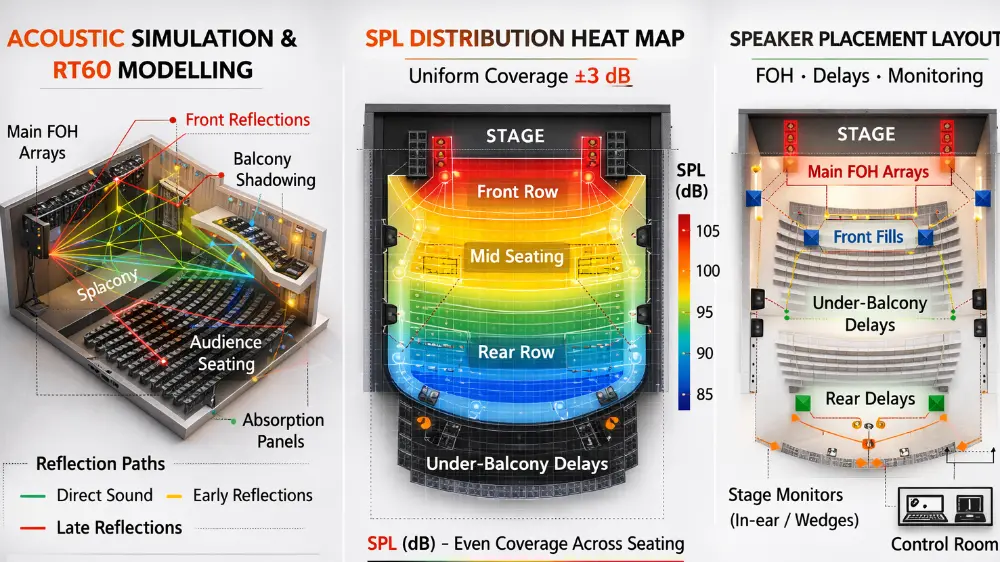
The technical challenge of deep-throw coverage is governed by the Inverse Square Law: sound pressure drops by 6dB for every doubling of distance. In a 30-metre-deep room, a single front-of-house PA pair cannot deliver consistent coverage without deafening the front rows. The correct solution is to delay loudspeaker reinforcement — secondary speaker arrays positioned mid-room and time-aligned to the front system, maintaining intelligibility at the rear without over-driving the front. This is a core competency in professional banquet hall sound system design, and it is where CSC Audio's integration expertise delivers measurable results.
Subwoofer placement deserves equal attention. Cardioid subwoofer configurations prevent bass energy from bleeding back onto the stage and into microphone capsules — one of the most common causes of feedback and muddied speech during live events. For large ballrooms with movable partitions and no fixed stage, portable sub-and-top systems on locking casters with dedicated floor wall plates provide the necessary flexibility without the visual and practical chaos of unmanaged cable runs across the event floor.
The Stage: A Fixed Asset, Not a Liability
Many venue owners resist a permanent stage on the grounds of flexibility. This is, in most cases, a false economy. A professionally calibrated banquet hall audio system is a precision instrument — the subwoofers and mid-high arrays are time-aligned and phase-optimised for the specific geometry of the room. Once the system is commissioned, the speaker positions cannot change. Moving them invalidates the calibration and causes the subwoofer and high-frequency content to reach the audience out of phase, producing a degraded and potentially unusable result.
A fixed under-stage subwoofer installation, combined with high trim-point rigging above the stage for top arrays, allows the system to project sound downward into the audience rather than scattering it toward the rear wall. The stage rear wall and immediate side-wrap surfaces must be treated with broadband absorption to eliminate early reflections — the primary destroyer of speech intelligibility and the reason untreated rooms produce feedback at lower gain levels.
The Three-Layer Sound System: A Standard for Premium Venues
The benchmark for a premium commercial banquet hall sound system is a three-layer architecture. Each layer is purpose-built for a distinct operational mode, and together they cover every scenario a busy multi-use venue will face.
Layer 1 — Life Safety: Fire Evacuation and Emergency Paging
This is the non-negotiable baseline. The voice evacuation and emergency broadcast system must meet local building code and EN54 standards, operate independently of all other audio systems, and override any active audio source instantly. It is infrastructure, not an afterthought — and it must be factored into the acoustic design, not bolted on at the end of a fit-out.
Layer 2 — Background: Ambient and Pre-Function Audio
The background distributed audio system defines the guest experience during arrivals, pre-dinner receptions, and interval periods. It should be a fully distributed network of high-fidelity ceiling or compact wall-mount speakers — never a single loud source. The goal is even coverage at conversational levels: a guest in the far corner of the room should hear the same music at the same quality as a guest beside the bar. This system is also where zone control and partition integration become commercially critical — when the hall splits into three private rooms, the background system must divide and operate independently, without any crossover of content between spaces.
Layer 3 — Foreground: Live Performance, Conference, and Celebration
The foreground PA system handles full-bandwidth live sound for weddings, concerts, and corporate productions, as well as the conference audio system for seminars, keynotes, and hybrid broadcast events. For corporate clients, this layer must support professional AV integration with live-streaming and multi-camera recording — an increasingly standard requirement for high-value corporate bookings. For wedding clients, it must deliver the dynamics and emotional impact of a live band or DJ without acoustic distortion or feedback. This dual capability is the cornerstone of premium venue positioning.
A keynote address and a wedding reception in the same building on the same day — this is the commercial goal. The audio system is what makes it possible.
Automation and Smart Control: The Banquet Manager's Interface
The most technically sophisticated banquet hall AV control system is commercially worthless if it requires a trained audio engineer to operate during every event. The operational standard for a modern multi-use venue is a touchscreen-based intelligent audio management system — a clean, waterproof panel that functions like a smartphone interface and requires no specialist knowledge to operate.
When a partition closes to divide the ballroom into three independent rooms, the audio zones automatically separate — the wedding music in Room A operates at full production level without a single decibel crossing into the corporate lunch in Room B. When the partitions open for a grand ballroom configuration, a single button labelled "Grand Ballroom Mode" brings every ceiling speaker, every subwoofer, and every microphone channel into unified, phase-coherent operation. The system is engineered so that a banquet manager — not a sound engineer — can walk up to the wall plate, adjust the microphone level for a wedding toast, and route background music to any zone in the building.
This is not a convenience feature. It is a direct operating cost reduction: venues that require a resident audio technician for every event carry a permanent staffing overhead that erodes margin on lower-value bookings. A well-engineered smart banquet hall audio automation system pays for itself in reduced technician call-out costs within the first year of operation.
Specify with Confidence. Install with Precision.
CSC Audio designs and supplies commercial banquet hall sound systems, conference AV solutions, and multi-zone audio control systems for developers, architects, and venue operators across Europe and internationally. Our engineering team works at the specification stage — not as an afterthought — to ensure that every system we commission is calibrated, compliant, and commercially optimised for the life of the venue.
Whether you are specifying a new banquet hall audio system, retrofitting an existing venue for multi-use operation, or tendering for a premium hotel ballroom AV installation, our team provides technical consultation, system design, supply, and full commissioning support.
Contact CSC Audio — Germany's leading commercial venue audio systems manufacturer — to begin your venue specification today.