Gym Audio System Design: A Zone-by-Zone Guide for Fitness Facility Owners
The global fitness industry is in a high-growth phase, projected to expand from approximately $120 billion in 2026 to over $235 billion by 2033. The sector is expanding rapidly as urbanisation replaces open spaces and the desire for physical wellness grows. Interestingly, women now make up 52% of gym members, while men account for 48%. Female membership has grown at a faster rate—32% over the last decade compared to 23% for men. Owing to this, and the fact that a sizeable portion of the population resides in high-density urban settings, environmentally controlled facilities—our modern gyms—have become the essential alternative for health and movement. These are now mushrooming as home gyms, professional clubs, corporate wellness centres, and facilities within hotels and universities. However, as the market saturates, the barrier to entry has shifted. Success is no longer about providing top-notch equipment; it is about delivering a premium experience backed by strategic, flexible pricing.
Good equipment, well-trained staff, and engaging, predictable programs are fundamental to a successfully run gym. Inviting top-notch bodybuilders, fitness trainers, or nutritionists makes a gym an "object of desire," while segmenting by demographic is another clear distinction a facility can make. However, even the best equipment in the world and top-tier trainers come to nought if the space does not provide a high-quality audio experience—specifically, excellent music that you can feel without it "screaming" at you. Every entrepreneur buys the best machines, but when it comes to the soul of the space—the audio system—they often fail to consider its importance. No one would buy a compromised treadmill, so why settle for a poorly designed, unprofessionally installed, loud, and distorted audio system that fails to motivate and simply blares from random corners?
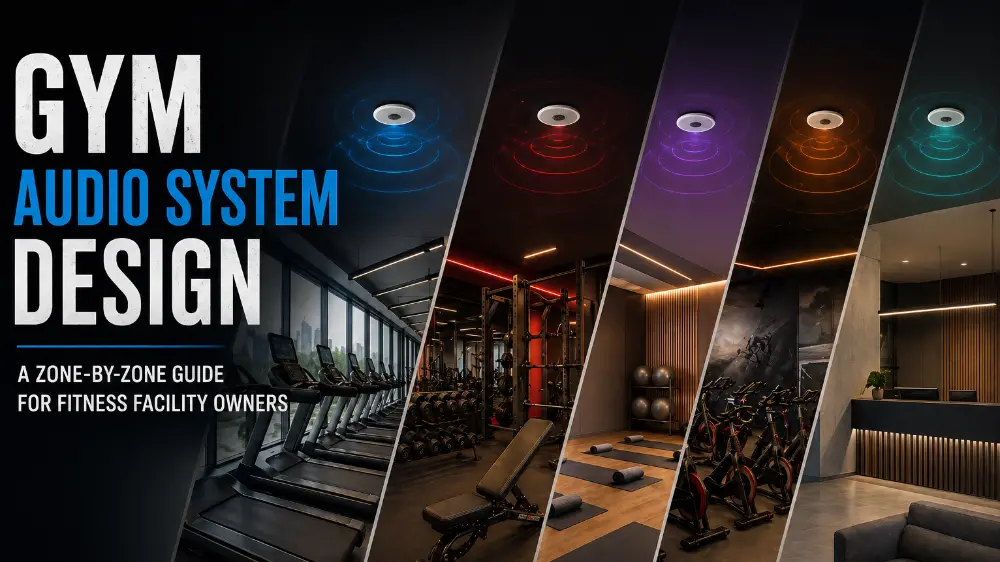
Modern mid-to-high-end gyms are typically divided into specific zones:
-
Treadmill/Cardio section
-
Free-weight and strength section
-
Yoga and dance studio
-
Spinning or cycling studio
-
Spa and massage areas
-
Coffee shop, changing rooms, and reception space
As you enter the gym, the cardio section welcomes you to warm up. The free-weight and strength training area is where the lifting happens, both physically and acoustically. This area is characterised by high ambient noise: weights clanking, humming treadmills, and the thud of medicine balls. In this space, you are competing with mechanical noise. To cut through the din without damaging eardrums, you need a professionally designed sound system that is powerful and distributed. Instead of a few massive speakers at one end, install multiple mid-sized speakers with an average nominal SPL of about 100 dB ±5 dB that can be produced by a loudspeaker with a Nominal SPL of 120 dB @ 1 metre. The "trick" is playing these speakers at 60% power, ensuring pure distortion-free music at an average of about 90db plus or minus 5 dB all across the space, depending on the age profile of your customer. This creates an enveloping effect with no distortion, ensuring a consistent Sound Pressure Level (SPL) across the room. To complement the mid-highs, you need powerful subwoofers to fill the room with warmth and energy.
In yoga or Pilates studios, the transition should be immediate. The high-energy buzz must vanish, replaced by spatial immersion. For spaces like these, in-ceiling speakers are the right tool — and the CSC MI 510 and MI 820 are engineered precisely for this purpose. Mounted overhead, they distribute sound evenly across the room, creating that coveted "voice of God" effect where music feels omnipresent — not coming from any single point, but from everywhere at once. A small subwoofer, tuned not to go below 45 Hz, fills out the lower frequencies, making the room feel "full" even at low volumes. This music acts as a "blanket" that masks outside noise without demanding attention. However, if the yoga room doubles as a dance studio, a powerful audio system is imperative — ideally integrated as a second layer for higher output.
Meanwhile, the indoor cycling studio acts as the "nightclub" of the centre. It is an environment where lighting and audio work in symbiosis to create a sensory escape. Using a Digital Signal Processor (DSP) to "duck" the music volume automatically when the instructor speaks ensures vocal clarity without losing momentum. For this zone, the CSC STW 28 or CSC CF 12 earn their place — both deliver the kind of club-grade output and punch that a cycling studio demands, and when paired with CSC CR 18 or CB215s subwoofers, they generate enough low-end power to double as a monthly member dance event without supplementing the system. In service areas such as locker rooms, moisture-resistant IP-rated ceiling speakers with PP cones should be used. This audio serves as a bridge, moving the customer from rich background music toward the high-energy workout zones while remaining quiet enough for conversation.
Creative Sound Concepts (CSC Audio) has several products designed specifically for gyms. The shape, size, and height of a space determine the choice of loudspeaker or system required. The general rule is to maintain even SPL throughout to ensure no one loses a beat or hears reflected sound. Using speakers randomly without understanding signal flow, delay, and phase correction can compromise the experience. In the audio world, the difference between "noise" and "sound" is like having the best ingredients to cook but no chef. For restricted ceilings under ten feet, the CSC CC8, CSC ST8, CSC ST 43, STW 28, and CF 205 each address this geometry well — and the STW 28 deserves a special mention: its 140-degree horizontal dispersion means a single cabinet covers the spread that would typically require two conventional speakers, making it the go-to solution for wide open strength floors. Where ceiling heights exceed twelve feet, mid-highs like the CSC CF 210, CSC CF 10, or CSC ST 12 are the right call, and pairing them with subwoofers like the CSC CB 15s, CSC CR210s, CSC ST 18s or CB 215s delivers the essential low-end thump that makes a large training floor feel alive.
For gyms in residential basements where traditional subwoofers are a non-starter because they disturb neighbours by transmitting low-frequency energy through the structure, the CSC CF 15 solves this problem cleanly. It extends down to 50 Hz — low enough to give members the physical sensation of music without the structural vibration that makes conventional subwoofers unworkable in shared buildings.
Finally, the style of music is critical. To maintain a premium global brand while respecting local tastes, play 70% recognizable international hits and 30% local cultural energy, such as Reggaeton in Latin America or modern Arabic Pop in the Middle East. In Europe, electronic music remains popular. Music must be context-specific, matching the physiological state of the members. Functional zones should have high BPM to align the heart rate with the beat, while cycle studios require curated playlists that mirror the class intensity.
Acoustics must be a top priority, though they are often overlooked. Acoustic treatment prevents a great playlist from becoming a muddy mess due to reflections from hard surfaces. Designers should first consider high-NRC tiles, curtains, wall panels, and broadband diffusers to calm reflections. This not only makes the space sound superior but also reduces ambient human noise. Owners should earmark $2–$12 per square foot for acoustic treatment, depending on the country, labour costs and size of space.
For professional audio hardware, the budget should ideally vary from 5% to 10% of the project cost to ensure proper zoning, control, and adequate headroom. All equipment should be housed in a central rack, yet every room must have its own local volume control and input. A simple touchscreen interface allows instructors to swap playlists or adjust mic gain with a single tap, ensuring the technology serves the fitness, not the other way around.
The Bottom Line
The difference between a gym and a premium gym is no longer the equipment. It's the feeling — and sound is the most powerful tool, which is underappreciated by owners and designers alike.
In the audio world, the line between noise and sound is the difference between having the finest ingredients and having a chef who knows what to do with them. CSC Audio's gym sound systems are engineered for exactly this — not to fill silence, but to shape experience, zone by zone, beat by beat.
Because in a market growing toward $235 billion, the gyms that win won't just be the ones with the best equipment. They'll be the ones that sound like they mean it.
Interested in a zone-by-zone audio consultation for your facility? CSC Audio works with gym designers, architects, and operators to deliver professional sound system design from concept to commissioning.