Understanding The Components Of A Loudspeaker
Loudspeaker is an electromechanical transducer that converts magnetic and electrical energy into mechanical energy, which excites the air molecules and produces audible sound waves. Due to several conversions, it is not highly efficient, and depending on the cabinet design, only converts 2 to 5% of the electrical energy into acoustic energy; the rest is wasted as heat, and hence heat management is most important and the hallmark of a well-designed driver design.
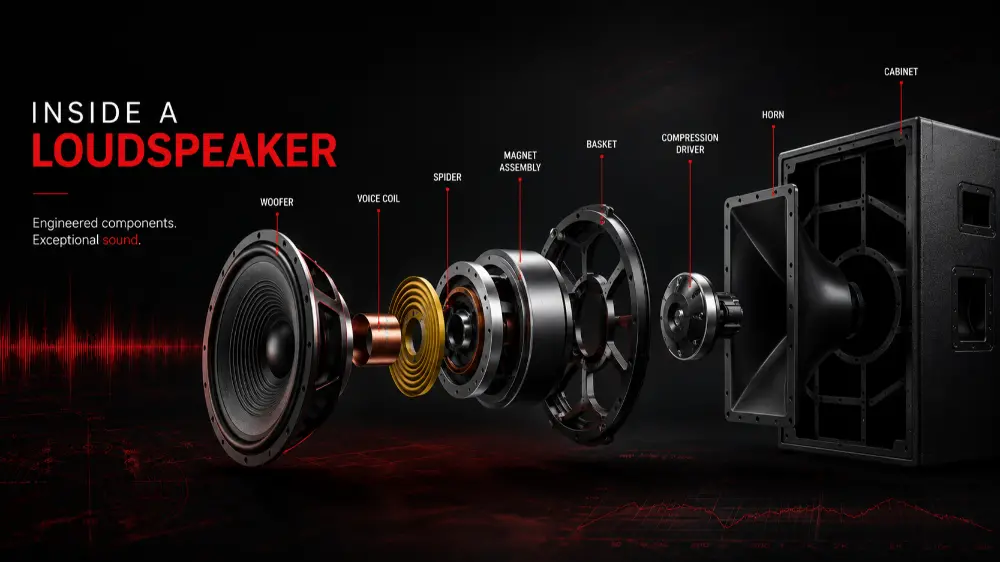
At the core of a loudspeaker lies a transducer, also called a driver—usually comprising a cone coupled to a voice coil, a magnet assembly, and a highly rigid chassis housed within an enclosure. When electrical energy flows through the voice coil, it cuts the magnetic field generated by the permanent magnet, creating a fluctuating magnetic field that forces the coil and attached diaphragm to vibrate. These mechanical vibrations excite the air surrounding them, creating pressure waves that our ears perceive as sound.
In-spite of being a highly complex to design and build with the correct technology and testing facility, several brands have recently mushroomed, and they make claims that are untested and unsubstantiated. Let’s dive into understanding what goes into a loudspeaker and what the facts are. The parts you see are:
- Low-frequency driver
- High-frequency unit
- Horn
- Cabinet
- Paint, grill, and hardware
Low-Frequency Unit
In mid-high/full-range loudspeakers, the LF driver produces low frequencies with a range of 55 Hz to 3000 Hz, depending on the application and the size of the driver. Both the low and high cutoff frequencies are dependent on the size of the driver, the type and size of the HF unit coupled with it, and the final application.
What are the variables in the driver that dictate its cost? A 12” driver can cost as low as $20 and go up to $400. Here is what dictates its cost:
- Size of the voice coil
- Type of winding on the voice coil
- The cooling system
- Cone material: Impregnated paper, metal, polymers, Kevlar, woven fiberglass, carbon fiber, or rubber-impregnated paper.
- Suspension: Single/double
- The chassis made from pressed steel, plastic, or cast aluminium. Cast aluminium is premium for its rigidity and heat-sink properties, reducing distortion.
- Type of magnet: Ferrite versus neodymium
- Type/grade of ferrite and neodymium
- Type and treatment done on the plate sets
- Type of former
Finally, the most important factor is the design and technology used to ensure a loudspeaker driver has minimum distortion at maximum power. This makes a loudspeaker sound clean and last long. Whatever specifications you read may look fancy, but the bottom line is how the final product sounds. The foundation of a top-notch speaker is laid by the drivers, and no driver without huge amounts spent on design and R&D can make an inexpensive driver have top-notch performance.
High-Frequency Unit
They are the foundation of how vocals and high frequencies perform. For example, an HF unit with a 1” throat and a 44 mm voice coil could cost anywhere between $30 to $300.
The type of materials, its parameters, response curve, and resonant frequency decide the application. In a sound system that goes into a top-notch lounge requiring non-aggressive, smooth, and warm tonality, Nomex, fiberglass composite, phenolic resin-impregnated linen, or polyimide like Kapton can be used. These are non-metal, high-performance, thermally stable, and durable, with a warm and smooth, non-aggressive high-frequency extension.
Titanium and aluminum are the most commonly used in professional PA and large-format arrays. They have high rigidity, are durable, and provide a bright, detailed, and projective sound. They are highly resistant to fatigue in high-SPL environments. If not designed properly, they tend to get harsh if driven hard.
While Beryllium is used in high-end loudspeakers, with a high stiffness-to-weight ratio, which allows for ultra-fast transients and minimal cone breakup, and hence, low distortion at the highest frequencies.
The price of an HF units varies greatly depending on:
- Size of the voice coil
- The cooling system
- Cone material (titanium and beryllium are expensive)
- Type of magnet: Ferrite versus neodymium
- Type/grade of ferrite and neodymium
A cheap HF may cost under $10 while a top notch high-end one a $1000. The price varies with the technology used ensures a loudspeaker driver has minimum distortion at maximum power. This makes a loudspeaker sound clean and last long. Whatever specifications you read may look fancy, but the bottom line is how the final product sounds at full power. The foundation of a top-notch speaker is laid by the drivers. The hardest part is the mating between the LF, HF, Horn, and crossover in a perfectly designed cabinet. This needs skill and huge amounts of investment in design and R&D.
Horn
This is the most critical part of a high-frequency section in which a HF units is acoustically coupled horn: This helps in
- Acoustical loading or impedance matching
- Directivity control, which decides the dispersion required
- Deciding the crossover point of the HF
You will find different companies have products with different dispersions; the reason is application. If one has a long room with the speakers needing to throw long distances without wall reflections interfering with the direct wave, you use a narrow-dispersion horn like a 40 x 40 (V x H). If, however, you have a shallow and wide space, you’ll need a wide-dispersion cabinet, for example, 160x40. Moreover, the size of the mouth of the horn dictates the crossover point, and if not chosen correctly, it will result in distortion.
Cabinet
This is where the magic happens. It isolates the rear, which is inside the cabinet, from the front, which is outside the cabinet. This ensures there is no cancellation between the two waves. The cabinet design, internal bracing, and materials are primarily chosen based on their durability, stiffness, and internal damping. The enclosure walls should be stiff and, under no circumstances, vibrate in response to the driver’s excursion. The vibration causes unwanted resonances that color the sound; furthermore, the cabinet loses its efficiency. Hence, materials used must be perfectly rigid. Cabinets with flexible walls resonate and ring, adding unwanted coloration to the audio.
Baltic Birch plywood is the industry standard for professional, high-output environments and offers an excellent strength-to-weight ratio and superior fastener retention, ensuring the cabinet survives the mechanical stresses of high-SPL operation without failing for years. Other materials that are used are MDF, aluminium extrusion, particle board, and plastics. Speakers made from extrusion need to be carefully designed using FEA to ensure they do not ring and have no standing waves. Most cabinets made from particle board and plastics are cheap, add distortion due to their vibrating walls, and are not environmentally friendly.
A cabinet ultimate success depends on internal bracing and airtight integrity. Proper bracing holds the enclosure walls to push resonances above the operating range, while an airtight seal ensures that the internal air pressure acts exclusively on the driver cone, maintaining the precise tuning required for accurate frequency response. Creative Sound Concepts only uses top-class birch and thick wall extruded aluminium for all their products.
The different designs in which loudspeaker cabinets can be built:
- Totally enclosed
- Reflex
- Horn-loaded
- Multi-load
- Band-pass
- Transmission line
Each technology is different and needs careful driver selection. They have their own application, advantages, and disadvantages. Totally enclosed and reflex are commonly manufactured by most manufacturers and are easier to design but highly inefficient, while all other technologies need skill and proper testing equipment. Creative Sound Concepts has products that cover most of the above designs ensuring all flavours for designers.
Paint and Hardware
High-quality hardware and professional-grade finishes are essential for any product, not just for the looks, but for its longevity due to vibrations. High-grade hardware such as bolts, nuts, gaskets, and grills ensures that the cabinet maintains its integrity even after years of use and does not rust. If the hardware fails or loosens due to vibrations and results in air leaks, it will cause chuffing and significantly degrade the low-frequency performance.
Similarly, high-quality paint or professional-grade exterior coatings, such as polyurea or water-based texture paint, serve as a protective layer beyond mere aesthetics. Polyurea is a hard and extremely durable, scratch-resistant paint which is rough and catches dust in dusty environments. Polyurea is scratch-resistant, but it is notoriously difficult to repair; once damaged. While texture paint can be repaired, is smooth, and does not catch dust, it is not as scratch-resistant as polyurea. The paint coat acts as a seal to the cabinet to prevent the wood fibers from absorbing moisture, which would otherwise cause the cabinet to swell, soften, and lose its structural rigidity over time. A professional finish also dampens the surface of the enclosure, providing an extra layer of protection against mechanical fatigue and impact damage, ensuring that the cabinet remains a dead, inert platform for the driver for years to come. At Creative Sound Concepts, we only use the best grade of birch for all our models, and all hardware is made from alloys that are carefully treated to stop oxidation.